Saturday, September 22, 2007

Hole lot of debt

More on the second Tyne road tunnel. The New Tyne Crossing Project Board has just announced that it's begging to be allowed to extend it's borrowing limit to £130 million and increase tolls. Since the second tunnel was given the go ahead by Alistair 'Rock' Darling in 2005, the project has rocketed up in price from £185m to today's announcement of £260m. Given that turf hasn't yet been cut, it's reasonable to expect costs to rise still further.

It's the kind of increase that would make the 2012 London Olympic committee proud.

Given the fragility of the wholesale markets at the moment, who is going to lend that kind of money, and if someone does, what guarantees will they want? The concessionaires can rely on HSBC and the Bank of Scotland, the Tyne & Wear PTA probably as yet don't have such luck. The current tunnel was bailed out in the 1980s when Newcastle City Council loaned the Tyne Tunnel money (interest free) to refinance the latter's loans because of the volatile lending markets at the time. £4.1m is still outstanding to Newcastle City Council.

Unfortunately veteran tunnel toll campaigner Stan Smith is too poorly to respond to this news, and there is little chance of local councillors having the nerve to call the Tyne & Wear PTA to account, so the announcement will probably go without challenge.

At a time when the finance industry is in such turmoil our politicians should be especially vigilant of dependence on debt. If the new tunnel does go awry, will the public be expected to bail it out again?


Wednesday, September 19, 2007

Yellows going green?

So far, Labour's effort in reducing carbon emissions has been a failure, with CO2 emissions increasing since 1997 despite countless speeches on the dangers of climate change. In particular it's handling of renewables has been pathetic, the incompetent management of micro renewables grants a specific case in point.

The only plus I can think of was the introduction of the Climate Change Bill, but since that had cross party support, and Miliband's minions ripped the guts out of it, I won't include that as a Labour success unless it hits the books as a strong climate law.

The Conservatives, apparently recent converts to green politics, seem to be suffering from a split personality - one side wanting to continue with more flights and more roads, the other trying to grasp the green nettle. It looks like Redwood's carbon spewing proposals have the Cameron favour at the moment, possibly because they are not too far from Gordon Brown's "concrete it" attitude to the environment. Depending on which personality wins will confirm if the Tories are genuine on the environment or just copying Labour's greenwashing.

So it's refreshing to see at the Lib Dem conference Environment honcho Chris Huhne calling for the country to be 50 per cent carbon neutral, with energy from "clean, non-carbon-emitting sources" by 2020, rising to 100 per cent by 2050. It's a courageous idea (for a 'mainstream' party) and what's needed - a strong target with a clear objective.

What's telling is that we haven't so far heard a peep in response out of Hilary Benn. Labour are so keen to try and outstep the Conservatives that they've missed the Lib Dems, although I'm not sure if that really worries them.

Let's hope that Hebburn Lib Dem Councillor Joe Abbott pricks up his ears and thinks about how the Lib Dems' new proposals can be realised in local terms, especially considering his objection to the proposed wind turbine at the A&P yard in Hebburn. Cllr Abbott has also got into the unusual frames of reference for the measurement of objects, saying that the turbine would be "six Angels of the North on top of each other". Since that particular gem seems to have originated from a Northumberland "No to Wind Turbines" group it suggests what's really informing his thoughts, and it's not what's coming from Chris Huhne.

Realistically, if we want renewable energy, we need wind turbines. Of course wind won't be able to provide all of our energy, so solar, tidal power, wave energy and other renewables as part of a balanced mix also need to be developed urgently, along with initiatives to reduce energy use.

In terms of siting wind turbines, my personal sequential preference is for offshore, then industrial site, brownfield site, urban areas and finally rural areas. Also, land based sites should be as close to the point of use as possible to minimise transmission losses through our aged grid. There is a fly in my preference ointment though - on the land wind tends to be stronger and more consistent in upland rural areas, so I wouldn't rule out rural areas - they need electricity too.

The infrastructure isn't yet in place to support offshore, so until it is we've got to go with onshore for quick wind energy wins and personally I think industrial, brownfield and urban sites should be treated as the next best option.

This is where the A&P development fits in. It's a working industrial site and most of the energy produced will be used in the yard. I can understand the concerns about the noise and the size of the turbine. Bejaysus, at 80m high plus the blades (or two Concorde jet planes placed nose to tail) it's big. But we need to remember this is a river which once had a skyline dominated by cranes, so I think in terms of visual intrusion it's replacing one industrial structure with another. As for noise, it's an industrial site and if the level isn't worse than what is already produced then there's no net disadvantage. Being a previous resident of Hebburn Village I can attest to the audible volume of ship hull sandblasting, but accepted it as the price for purchasing a house in an industrial area.

It's disappointing though that the planned turbine (as with others erected locally) is going to be imported. As shipbuilding was winding down on the river an opportunity was lost to shift the massive resource of first class engineering skills from building ships to building renewable generation units for wind, wave and tidal power. In the past the Tyne was famous for exporting coal; in the future the Tyne could be exporting clean green energy. Even though I don't believe in Karma, if I did there would be a poetic green Karmic balance somewhere in there.

Hopefully in light of the Lib Dems' new aspirations for CO2 reductions Cllr Abbott will reconsider the plans more seriously than dismiss them with a knee jerk. However, given his (and Newcastle Lib Dems) support for the second Tyne road tunnel, I'll not be surprised if he continues his business as usual attitude.



Tuesday, September 18, 2007

Smash and Gran

First they destabilise the finance industry, now they're smashing up Metros - is there no way to stop the OAP menace?

The results of a review of an incident in May involving an electric scooter, an octogenarian and a Metro train door by Metro safety inspectors have been reported today in the Gazette.

The inspectors reported that Mrs Dees, 80, had hit the Metro doors with an equivalent force "of a rhino ramming the door". Have we started to quantify impact force in units of rhino because of the dropping of metric measurements? I'm looking forward to the return of the double decker bus to measure height.

I'm not sure quite why such an apparently powerful vehicle requires a "bull-bar" style front bumper - perhaps to see off any rampaging elephants on the Jarrow savannah.

These electric carriages are unregulated and the only qualification needed to drive one is the cash to buy it. The one in the incident reported didn't even have brakes, presumably relying on the inertial resistance from the electric motor to stop. Then again, who needs brakes when you have a choice of handy crumple zones: Metro doors, someone's shins, a push-chair?

These things are everywhere. You can't walk down the shops without having to dodge these pavement dodgems, and I've even seen one on the access road to the Tyne Tunnel. Soon they'll be travelling in gangs terrorising poor hoodies. The police will need a special electric scooter force to bring these ruffians to justice. Just as soon as they've charged up.

This menace must be stopped now.


Monday, September 17, 2007

Time for a climate scare?

It's despairing that in the 21st Century people can be so easily panicked. The trials of Northern Rock is a classic example of mass hysteria, which leads me to think that, along with the growth of religion, 'intelligent design' (I know, it's a facet of religion, but it's special because it pretends to be science), and climate change scepticism there is an ongoing assault on reason.

The Northern Rock incident has made me think that if people took the threat of climate change as seriously as a manipulated media event then the UK would be running carbon free in a year.


Rock hammered

Northern Rock has long followed a model of borrowing short and lending long to fund it's growing mortgage business, which has so far provided the company with massive success. But the folk standing in the queues don't hear this.

To these folk, it doesn't matter that Northern Rock is looking at making at least £450m profit this year, or that the bank is otherwise in a financially strong position. It doesn't matter that Northern Rock, unlike Barclay's which was twice bailed out by the Bank of England last month, has yet to touch a penny of the Bank of England loan facility.

It also doesn't matter that, the more that people withdraw, the greater chance that Northern Rock will be taken over, which would mean massive redundancies in the North East's biggest finance industry employer. It doesn't matter that the loss of Northern Rock would also mean the loss of the Northern Rock Foundation, the biggest charitable giver in the North East, which could also mean goodbye to a number of local charities and good causes.

All these people see are the queues, and all they hear are the interviews with the headless chickens (although the rush to join the queues is more like a flock of sheep if you want to continue the farming analogy). To a large extent, the media herd has driven the events, starting with the BBC's misleading labelling of Northern Rock's request for the Bank of England facility as 'unprecedented'.

It's been interesting to follow the media coverage. Everyone with an opinion, including inveterate band wagon jumper Dave Cameron, has been falling over themselves to criticise Northern Rock or the government for not predicting this. Hindsight is indeed an exact science, but the reality is it couldn't be predicted. Of course there were risks in Northern Rock's model, but no one foresaw all the banks shutting their doors to short wholesale borrowers like Northern Rock. Normally, the banks loan money to each other, but Northern Rock and others were locked out by the liquidity freeze.

In a tsunami of silly media comment and downright stating the bleedin' obvious that has more in common with football than finance, the most idiotic comment award has got to go to ITN's annoying Chris Choi, who tonight called the queueing an "investor revolt", as if those people in the queues were on some honourable crusade, rather than a panic of self-interest.

Hopefully tonight's announcement by Alistair Darling will cool some heads amongst Northern Rock customers, quieten the nerves of staff and stave off a takeover, which would be disastrous for it's employees. And judging by the speed at which the queues dissolved when the rain started at 3pm in Newcastle this afternoon, here's hoping for a bit of bad weather to help restore calm.


Friday, September 14, 2007

Freedom fries

Simon Jenkins' comment piece in The Guardian, reflecting upon the abandonment of our freedoms pretty much echoes my thoughts. It's disappointing that so many of our politicians are happy to see our liberty dismembered, some of them even cynically trading on the emotive 'remember 9/11', apparently unaware that each freedom lost in the name of security is a small victory for the terrorists.

Thursday, September 13, 2007

Jesus saves... on bus fares

What do you get when you cross bureaucracy and religion? Idiocy.

The news that 11-year-old Elliott Stewart from Brasside in Durham has been refused a free bus pass to get to school, just because he hasn't been baptised, would be worthy of the sitcom Father Ted, if it wasn't true.

Durham Councillor Clive Robson said (presumably not realising how stupid it sounds):

"Although a child does not have to be a Roman catholic to attend a Roman Catholic school, he or she and at least one parent has to be baptised Roman Catholic to be considered for free travel to it."

So, it seems a ritual splash of water is all that is stopping Elliott from enjoying free bus travel to school.

In an attempt to make it appear that faith schools have become more open in their admissions rules, policies have been changed to allow children not baptised in the Roman Catholic religion to enrol in a Roman Catholic school. But the mechanism that would allow Elliott to have the same opportunity of access to school as his schoolmates doesn't exist.

But rather than put their hands up and admit it's a silly rule, and that special dispensation will be given for Elliott until the policy is changed, the jobs worth drones at Durham County Council have stuck to the tried and tested 'rules is rules' excuse, with a the 'Ombudsman sez so, so there' for good measure.

How long before Durham becomes known as "The Deep South of the North East"?

Tuesday, September 11, 2007

Numbers

It's been ten days since my birthday, and an apparently 'significant' or 'watershed' one at that. I've never been too bothered about my own birthdays and don't like fuss, although I try to be vigilant in remembering others'.

However, there is one special thing about the day. I treat my birthday as a day not about me but my mother, recognising what she went through on that day to bring me into the world. Unexpectedly, this made for a more personal and meaningful day than the current Mothers Day card-fest, and the practice has now become a tradition that's passed onto my son.

As this birthday was supposed to be significant for me, it's caused me to wonder precisely why it's significant. Many significant birthdays are related to key life events - 13 - the first teen year, 16 - the age of consent and to bear arms for the state, 18 - the right to vote and purchase alcohol. After 21, birthdays move to decimal years - 30, 40, 50, 60 and so on; 10 years apparently being an arbitrary period of note.

But I couldn't find anything definitive on this one. I suppose there's the argument that any celebration is a good thing, but the only conclusion I can come to is that measuring years in tens must mean something to someone other than greetings cards manufacturers, but not to me. Maybe there's some kind of birthday bingo going on and I haven't been given a card.

I don't feel 14610 days old (well, 14620 now) at all. I don't know if you are supposed to 'feel' a particular age, but something I've noticed about this one is that everyone is asking if I do.

That's worrying. I still haven't worked out what I'm going to do when I grow up.


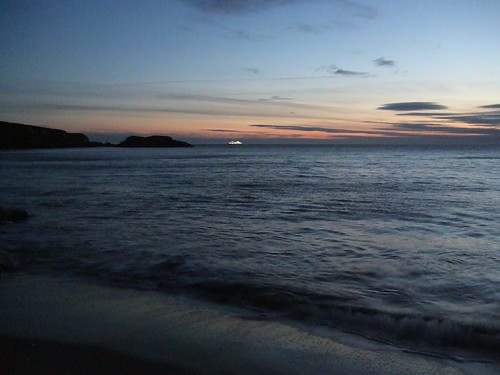
Dawn on day 14610

Day 14610

Friday, August 10, 2007

Guilty pleasures

Cancer Research UK has released research that some cancers have risen due to our lifestyle. Cancer is now characterised as a kind of earthly retribution - paying for the sins of a hedonistic lifestyle - eating, drinking and tanning yourself to death. A timely message perhaps, given that many will be off on their jollies to abuse (enjoy?) themselves in such a manner. CRUK have also kindly provided a twenty page brochure on what you can do to reduce the risk of cancer.

I explored the brochure , where it illustrates the reduction in the number of people smoking has been reflected in a reduction in deaths from lung cancer. The document also rightly emphasised the importance of early detection and prevention. The main message is that personal responsibility is key.

The brochure also heralded a new £12m research project "on health behaviours associated with tobacco use, diet and nutrition, obesity and physical activity, which are major risk factors common to several major disease groups".

I think the conclusions will be pretty obvious without the need to spend £12m - don't smoke, eat a balanced diet and exercise. Pay me please.

However, whilst the brochure calls for personal life changes to prevent cancer (nothing wrong with that), nothing is mentioned of external factors - chemicals and hormones in food and water, cosmetics and household chemicals, pesticides, heavy metals, air pollution, and a whole host of other environmental nasties. Indeed the word environment doesn't even grace the pages.

Now as you've probably guessed, I've got my Waste Management Strategy hat on at the moment so I also explored the brochure for the mention of incineration's biggest risk - dioxins. You guessed it, it's not there. I looked on CRUK's website, which dismissed dioxins as "a group of chemicals that are formed unintentionally by industrial processes such as burning fuels and incinerating waste". The word 'unintentionally' stinks of appeasement. It's like the pharmaceutical euphemism 'side-effect' or the military one 'collateral damage'. We know it happens - but tough shit babe, you can't do anything about it.

Some press releases from CRUK even downplay research suggesting links between the environment and cancer - comments that wouldn't be out of place on a government or chemical company press page.

That environmental factors have become the silent elephant in the room invites accusations that CRUK aren't being entirely honest. The cancer charities should be out shouting on the streets as loudly about the environmental risk factors as they are about their new 'live healthy' guilt trip.

But if they did, would they suddenly find funding dry up?


Wednesday, August 08, 2007

God bothered

A couple of weeks ago I attended a meeting at a South Tyneside primary school and saw something I found to be disturbing. This school is what's commonly known as a 'faith school'. I've never visited a faith school before.

These types of school have never bothered me much, except perhaps for their discriminatory practices where children from families with the same religious orthodoxy as the school would get enrolment priority before children from another religion or from a non-religious background. Often these schools are defended not on the basis of religion, but that of education - statistically, those who attend faith schools tend to do better in exams than their contemporaries in mainstream (not overtly religious) schools.

It could be that a culture of religious belief is responsible for the grades, or that children attending these schools tend to come from homes which value and instill aspiration, hard work, discipline and reward. Or a bit of both.

At the meeting my mind wandered during a particularly dull discussion and my eyes scanned the walls of the school hall for a bit of light diversion. I found a section on wall which could be summarised as "Postcards to God". The wall contained a number of small cards with a short bit of text on them. Here's some examples:

"I belong to God's family, I feel special."

"I belong to God's family, I feel loved."

"I belong to God's family, I feel happy."


And so on. Each card also held the name of child, and by the handwriting I would guess the age of the authors to be around 8 to 10 years old.

This is when it struck me how divisive faith schools are.

As an aside, I must admit, I don't even like the term 'faith school'. The two words somehow seem incompatible with each other. Faith is something you believe without reason or evidence. It's the ideology of ignorance. Where children are 'taught' creationism as an alternative science to evolution, as in places like the Christian fundamentalist Vardy schools. This is loony indoctrination, not education.

The subtext of the Postcards to God is one of group superiority. "I belong to God's family, I am special" logic has a flip side which implies that those who don't belong to God's family are not special, not loved and somehow less worthy.

The world of religion is full of terms for those who don't follow your particular cult - gentile, unbeliever, infidel, heathen, heretic - all pointing to those outside your religious 'family' with an alien otherness. It's fortified with lessons that those who don't believe in your god and follow the rules are going to spend the afterlife in an eternity of torment, whilst believers and martyrs will be rewarded with an eternity of infinite bliss in paradise.

Sounds pleasant, but from such ideologies killers are created, comforted and confident that their god approves of and rewards their atrocities.

We could point fingers and select religions for particular criticism. Suicide bombings by Muslim extremists are a recent manifestation of killing in the name of religion. But Muslims who have lost their marbles don't have all the fun to themselves. Scratch the surface of an atrocity and chances are religion is somewhere underneath.

The cash to run faith schools comes from tax payers, who are funding the ignorance and indoctrination of next generation of religious bigots. Schools should be where we teach our children how to think - not what to think.

Thursday, August 02, 2007

WOT, no War On Terror?

Gordon Brown's avoidance of the phrase "War on Terror" confirms that the term will no longer be used by UK government officials. It's seen as a change in direction where terrorism is redefined as a purely criminal action, stripping any context which might prompt examination of motives.

With an election looming Brown will want to avoid any terms linking himself with Tony Blair's handling of terrorism, so changing the landscape of the language used is a key tool.

This is a common marketing technique - rebranding. It's a bit like changing the name of the Marathon bar to Snickers. The product hasn't changed, just the name.

But the ghouls of extremism are still there, and Brown is going to stoke the fear of them to keep the rest of us terrified. Despite the change in arse keeping the PM seat warm, our government continues to invoke 'terrorism' and 'security' in order to control.

Move over Poodle, here's Scottie.

Conjuring the spectre of 'rogue states', the government's announcement that it is going to allow the USA, without any debate in Parliament, to use the listening station at Menwith Hill for it's nuke treaty-busting 'missile defence system' indicates that Brown views democracy with the same contempt as Blair. It also shows that Brown, like Blair, puts Bush's interests before that of Parliament. In a world teetering on the edge of a new cold war, Brown happily helps Bush to tip us into a new arms race.

Corporations are getting in on the 'security' act to quell protest, as is seen in BAA's attempt to stop climate protesters enjoying their liberty to demonstrate peacefully.

Like the Marathon rebranding, the War On Terror market repositioning exercise is being used by Brown and his chums to continue to sell us something that is as sticky and nutty - the erosion of our freedom and democracy.


Wednesday, July 25, 2007

Lazy press

Last week's Riverside CAF meeting promised to have it's fair share of controversy and political sniping. And it didn't let those present down, with some rather enjoyably acerbic exchanges between councillors John Anglin and Jane Branley.

However, there was no Gazette reporter present. The Gazette had been forewarned that the Riverside CAF meeting would be an exceptional one. Unfortunately the Gazette declined to send someone. Perhaps the Gazette's ace reporters were on holiday.

This is just one example of a local journalistic decline. The Gazette prints (copies and pastes?) council press releases without question, making the newspaper appear part of the local New Labour PR machine. It's difficult for the Gazette to deny this when you consider South Tyneside MPs Miliband and Hepburn, and Labour council leader Waggott, all have regular spots in the Gazette.

It would be naive of me to expect no political bias. However, the feeling that the Gazette is excessively council-friendly was reinforced in the run-up to the local elections when the paper was bursting with Labour councillors gurning in photo ops and taking credit for mediocre successes, which coincidentally all happened to be resolved just before the elections.

The Gazette has started to fill space with stories from Sunderland. Page 2 of the Gazette should be referred to as the 'Sunderland Echo Echo' page, since that's where the pieces are lifted from. There's no shortage of news in South Tyneside, just a lack of willingness to dig out the stories. Tuesday 24th July's Gazette is a case in point. There are massive issues currently facing the borough, but the centre pages feature an airhead two-page spread plugging the Gazette 'spook' reporter's (if there is such a thing) new book on imaginary friends.

We get the basic luck news stories, but there's no real accounting taken of local politicians and comment is left to the letters page.

If the Gazette fails to adequately cover what's really going on politically in South Tyneside then it's failing it's readership. The paper's editor should be ashamed that local bloggers are reporting and analysing the news that the Gazette can't be arsed to do.

A free press is important to democracy - but only when it fully reports on the actions of those we put into positions of responsibility. Otherwise it's just fluff and marketing.


Tuesday, July 24, 2007

Coastline sidelined

Here in South Tyneside, we have one of the most beautiful coastlines in the UK, made more remarkable by it's easy accessibility. In Saturday 14th July's Guardian there was a free magazine featuring the UK's best seaside attractions. South Tyneside featured once in it's plethora of top tens, and that was for seaside pubs, namely the Marsden Grotto. It's a unique and remarkable pub, cut into the limestone cliff face opposite probably South Shields' most famous landmark and natural feature, Marsden Rock (which the Guardian piece fails to mention). But frankly the pub has seen better days.

It's a real disappointment that the massive spread of coast missed out on any of the other 'Top 10' features - the sandy beaches, the excellent coastal path, the impressive Frenchman's Bay, Souter Point and it's lighthouse, and of course, Marsden Rock.

How someone could only mention Marsden Grotto and miss all these other attractions only leaves me to conclude that the reporter visited on a cold wet foggy day, and the pub was the best place to be.

Dscf2108b

Thursday, July 19, 2007

Talking rubbish

Not content in allowing the Progressives to get all the stupid is as stupid does action, South Tyneside's Labour councillors are now also weighing in behind incineration. At the Riverside CAF meeting on Thursday 19th July, Councillor Ed Malcolm threw his reputation behind "Energy from Waste" (yes, I know it's a spin word for incineration) as a 'solution' for dealing with the waste we don't recycle or compost. Councillor Michael Clare assured everyone that "no incinerators will be built in South Tyneside"; but it does allow plenty of leeway for building them in nearby Sunderland or Gateshead. I can almost hear the people of Wrekenton groaning.

Councillor Malcolm seemed anxious to let everyone know that EfW (yes, I know, burning rubbish) isn't as bad as it used to be, and verbally painted a rosy image of free energy and heating for homes. He missed out the less than tinted bits about the carbon dioxide emissions, heavy metal particulates and our old cancer causing chums dioxins. He also missed the point that incineration reduces take up of recycling. Oops, and you still have to find somewhere to bury the toxic slag that's left over.

I'm sure the people from Byker have a lot of good things to say about EfW incineration. Well, the one's who didn't get cancer anyway.

Coincidentally, Ed Malcolm's brother, Deputy Leader Councillor Iain Malcolm, has a financial relationship with rubbish supremos Premier Waste Management, although I'm sure Iain Malcolm removes himself from such discussions in council.

I suppose it should come as no surprise that Labour councillors support burning rubbish. Labour councillors support the second Tyne Tunnel, backed concreting the Fellgate greenbelt and proposed planting a training shed (sorry, 'superschool') on Temple Park. Given that Labour and Progressive are supposed to be at opposite ends of the spectrum, when it comes to incineration how do they both manage to take the same ground at the same time?

When it comes to rubbish ideas our councillors are world class.

Has no-one told them - there's no such thing as a safe level of pollution?


Wednesday, July 18, 2007

Wasted targets

Further exploration of South Tyneside Council's Draft Joint Municipal Waste Management Strategy reveals another example of target-itis. Here we have the policy aspiration for recycling:

"Policy 7: The Partnership will aim to achieve the following recycling / composting targets:
- 30 per cent by 2010
- 35 per cent by 2015
- 45 per cent by 2020"

Look impressive? Challenging? Compare South Tyneside's aspirations compared with what other UK councils are doing now:

Top 10 recycling councils:
North Kesteven 51.5 per cent
Rushcliffe 49.9 per cent
South Cambridgeshire 49.4 per cent
St Edmundsbury 48.6 per cent
Huntingdonshire 48.0 per cent
Melton Mowbray 47.1 per cent
Waveney 46.6 per cent
Forest Heath 46.1per cent
Teignbridge 45.4per cent
Lichfield 45.4per cent

These councils are beating South Tyneside's 2020 recycling target now.

Like the Council's pathetic 'target' to reduce it's carbon dioxide emissions by 5 per cent over 5 years, it seems the council only like targets which are easily achievable with the minimum output. It looks good on performance target press releases I suppose.

If the council wants to avoid accusations of being cynical and lazy, it (and that includes councillors too) really needs to up it's game and aim higher.


Tuesday, July 17, 2007

Burning ambitions

South Tyneside Council has launched it's consultation process covering the new Draft Joint Municipal Waste Management Strategy which will take us to 2020. Among the commonsense "three R's" (reduce, reuse, recycle) proposals, the council is raising the subject of incineration.

South Tyneside Council has entered into a partnership agreement with Gateshead and Sunderland councils to establish the new waste strategy.

Incineration is proposed as one of the possible methods of disposal for the waste which we cannot (or we can't be bothered to) recover. Since the terms 'incineration' and 'burning' aren't easy to sell, the process comes under the wizzy euphemism of "Energy from Waste" (EfW) or "energy recovery".

If incineration is selected there's a rumour that the preferred site is on the site of the former incinerator at Wrekenton, on the border between Gateshead and Sunderland, although it should be noted there is no official documentation supporting this.

So soon after seeing off the industrial park on the green belt at Fellgate, and the rehabilitation of the Monkton cokeworks site it seems that residents in that part of South Tyneside may be faced with another dark environmental cloud. Not to mention the people in the Wrekenton area who thought they'd seen the last of local waste incineration.

Dioxins are a pretty nasty bunch

Incinerators release dioxins and heavy metals, which can cause cancer, birth defects and endometriosis.

The rise of endometriosis – a painful condition possibly afflicting as many as ten per cent of British women – is linked to emissions of dioxins. British mothers carry in their breast milk levels of dioxins which significantly exceed the World Health Organisation’s recommended “tolerable daily intake”, partly due to the widespread incineration of hazardous waste.

Studies have repeatedly linked dioxins to both breast and testicular cancers.

A study by the US Environmental Protection Agency suggested that as many as 7 per cent of all cancers are caused by dioxins, mostly from incinerators.

Progressives - the crazy bunch?

At the East Shields CAF meeting on the 5th July Progressive Councillor and Progressive Party leader Jim Capstick nailed his colours firmly to EfW (yes, that's incineration) as his party's preferred method of disposal for the waste designated as 'unrecoverable'. The Draft Waste Strategy concedes that incineration "will generate additional hazardous waste".

Quite why his party is called 'progressive' is odd. They have lent their support to a practice which will damage the environment and will precipitate a new crisis in public health. The victims will be among the poor and the young. In my understanding this is about as far from progress as you can get.


Thursday, June 28, 2007

Poor rating

Online Dating

I need to get more hardcore!

Hat tip: prisonlawinsideout/

Tuesday, May 15, 2007

Human touch

All too often designers are criticised for ignoring the human element. Sometimes it's through poor specification or implementation, or sometimes intentionally to accentuate a design aesthetic.

In terms of usability, design can decide success or failure.

For instance, when designing software user interfaces, poor design can not just define whether a product works or not, if done badly can lead to health problems; unclear text causing headaches, too many mouse movements and clicks leading to RSI. This is called Human Computer Interaction, or HCI for short. When software testers talk about software being 'intuitive', 'organic' or 'natural' in operation, this often reflects the amount of work that the developer has done to ensure the most comfortable user experience.

bad_design02


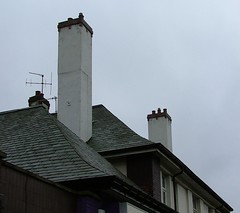
But when it comes to South Tyneside Council, design seems to have become a function of expediency. The awful fake chimneys on the former Nook public house won a design award for 'innovation'. They were introduced to allow a mobile phone company to hide their telecommunications equipment. Three years later and the appearance of these 'innovations' just gets worse.


quadrus_centre02The Quadrus Centre


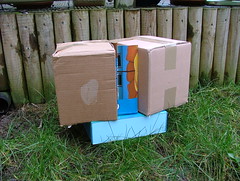
The cubist monstrosity of the Quadrus Centre is another example of design which seems to be ugly form more than pretty function. However, South Tyneside Council seems desperate for a signature icon to represent it's aspirations for a thrusting entrepreneurial culture, so if the council feels a couple of oddly placed boxes do the job, then who am I to argue?

'Streetscape' design though, is less esoteric than the concepts behind Jenga wannabe Quadrus.

Street planning, if done badly, can mean the difference between life and death. Streetscape isn't just about green verges and pretty flower planters, it serves a 'mission critical' function.

bad_street_design
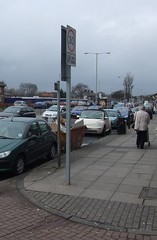
Walking along the Nook shopping centre I came across what has got to be a beacon of council design incompetence. The road sign to the left has been positioned in such a way that 4 feet of pedestrian space has been effectively removed, also creating a pinch right next to a road crossing point. In this one simple instance, pedestrians have been failed by the road planners.

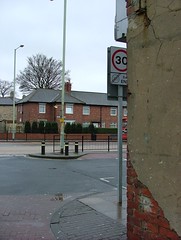
However, looking at the sign from another angle (image below), from a driver's perspective, and the realisation of impractical planning practice is complete. The sign's position means that it isn't visible to drivers coming out of the lane until they are 7 feet away from the end of the lane, a busy pedestrian crossing point.


bad_street_design02


I'm sure that the planners have followed all the neccessary rules and regulations and that the sign's position is perfectly legal. However, the sign's position is not sensible, not for pedestrians or drivers.

There are practical alternatives. One could be to extend the 20mph zone to the perimeter of the parking area adjacent to Prince Edward Road, and place the sign at the exit from the parking area onto Prince Edward Road. However, this would likely require changes to road orders and byelaws. A simpler alternative would be to move the signpost closer to the road, a matter of two feet, remove the existing signpost which holds a parking restriction sign, adding the parking restriction sign to the speed signpost.

It seems like a big deal all because of a simple street sign. But if the Council can't get the little things right, then what hope have we for the big projects?


Sunday, May 13, 2007

Soft target

Taking time off from massaging easyJet's overblown eco ego, South Shields MP and Environment Secretary David Miliband yesterday hosted the "Climate Change Citizens' Summit" in London, with the objective of highlighting "the need for government, business and consumers to work together to reduce CO2 emissions." Sounds like a great idea - let's get citizens involved in working out solutions to our rising carbon emissions. But there seems some confusion over contexts here though - was it a citizens' summit or a consumers' summit? It seems like our Government doesn't know the difference between a citizen and a consumer, which is disturbing.

And hold on, which citizens were attending? Apparently, they were "...a representative sample of 150 people, recruited from six locations around the country...". I'm sure the citizen representatives are righteous people, but how 150 hand-picked people out of a population of 65 million can be termed as 'representative' is difficult to comprehend.

I'm hoping that the event wasn't managed to achieve preferred outcomes - ie giving the Government the opinions it wants - but given the history of this Government I may be being a little optimistic.

If the nu-Lab command and control machine does have the climate change Bill in it's sights then we can say good-bye to the controls that a coherent Climate Change Bill requires like annual targets and ministerial accountability.

But considering that Richard Lambert, Director General of the CBI and Brendan Barber, General Secretary of the TUC were speakers at the event I've got to wonder if it's part of an attempt to warp the Bill to be as business friendly and pro-nuclear as possible. I know it's important to get business buy-in in the battle against climate change, but self interest groups like the CBI already have an enviable level of access to Government, and when they're given the keys to influencing supposedly 'representative' events like this it's reasonable to suspect the Government is putting the interests of it's chums in business before saving the planet.

Given the Government's policy of appeasement towards the road building lobby and the aviation industries despite the increases in emissions, at the moment there's little hope of what is needed - a strong government not afraid of using regulation to do what we need to survive.


Friday, May 04, 2007

Guilt trips

Quite often anthropogenic climate change is characterised by it's opponents as a faith structure or religion. If that's the case then a church has arisen around this religion and the money lenders are already in the temple. So it's fitting that Environment Secretary and South Shields MP David Miliband had an audience with the Pope last week, as the Church of Rome and the Church of Greenwash have a very similar stance on guilt.

In the Roman Catholic Church sins are forgiven through the acts of confession, contrition, penance and absolution. During the Middle Ages the rich could buy absolutions from priests to avoid eternal damnation. Those folk knew they could carry on sinning, comfortable in the knowledge that they could buy themselves out of hell.

In the Church of Greenwash, burning fossil fuel is the new sin and like the Roman Catholic Church in the Middle Ages, absolutions can be bought. We don't call them absolutions now though, we call the process offsetting. I have a problem with offsetting - it's complete bollocks. It doesn't do anything to reduce emissions. Once you've flown to Paris for a tenner your share of the emissions is out there - and they're going to be around for a very long time.

Offsetting is not so much absolution as an absolving of responsibility.

In Tuesday's Guardian Monsignor Miliband praised budget airline easyJet for promising a scheme where it's passengers can purchase offset credits from easyJet. To back his support for offsetting, he said:

"Businesses and consumers need to be sure that the way they offset actually results in a robust and verifiable emission reduction."

To the objective eye this seems like a reasonable statement, but he followed up with:

"That's why the government has consulted on a proposed voluntary code of best practice for all providers of offsetting products and is now considering the responses."

Voluntary. Let's think about that word. It's certainly not a synonym of "robust". Then think of the phrase "best practice". My spidey senses tell me that Miliband didn't really mean "robust" at all. Translated out of Westminster bullshit into English it really means "businesses can do what the fuck they want". That's New Labour's dogma - let's talk about how terrible climate change is, but never actually do anything about it that may upset our chums.

In Rome, Mr Miliband and Pope Benedict called for a moral and ethical approach to climate change. To most sensible folk this is a no-brainer - if it's not dealt with global heating can bring about the deaths of millions, if not billions, of people.

As an aside - if Pope Benedict wants to reduce the Catholic Church's carbon footprint then a good start would be to look at the human footprint. He could kick in the Church's support for family planning, including contraception, straight away. Less people on the planet means a bigger share of the planet's resources for everyone.

But on the ethical conundrum, the problem is that most businesses don't know how to be ethical - their prime function is to make profit. Profit in itself is neither good or bad, it's merely an economic surplus. It's how the profit is made that defines it's moral and ethical boundaries. For most citizens we have laws drawing those boundaries. But in the UK there is no law saying that businesses should act ethically or in the interests of society. Gordon Brown saw to that by ripping out the corporate social responsibility reporting requirements for companies' financial reports.

But offsetting gives businesses a chance to sell themselves as somehow caring and responsible, whilst not actually doing anything to reduce their emissions and profiting off the enviro-guilt of their customers.

If businesses and consumers need to be sure of anything, it's that offsetting is nonsense. It produces nothing but apathy and feeds the current ambivalence towards the environment and the peoples in other countries who are going to feel the pain of global heating before we do.

Offsetting promises guilt-free polluting but gives us business as usual and sod the planet.